

Contrary to what some especially benighted and provincial neo-Cold Warriors, especially among the American “elite,” still can’t wrap their heads around, contemporary Russia is not Soviet, Communist, or even socialist. Instead, in precisely one way, all the over-confident Western “transition” experts of the 1990s did get their fondest wish: Russia is now as capitalist as can be.
Otherwise, of course, nothing worked out as they had planned, imagined, and dreamed: Russia has not become a subservient part of a “globalized” world order under Western, that is, ultimately American command. Since, at the latest, 2007, its leadership has resisted, ever more directly, resolutely, and successfully, the permanent degradation to second-rate power this would have required.
Moreover, recently – largely together with China – Moscow has also turned into a leading force in not only challenging and stymying Western claims to global dominance but organizing alternatives (most importantly the BRICS+ association) that strive to facilitate the multipolar order which is – inevitably – going to supersede a declining America’s always somewhat delusional “unipolar moment.” Russia, in short – and, again, next to China – has re-emerged not only as a modern great power (its normal international position since, at the latest, 1721) but as the post-Cold War West’s most important and, as the war in and over Ukraine has shown, very effective geopolitical opponent.
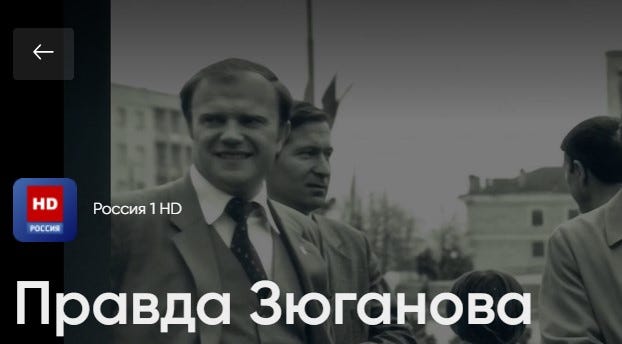
It may be counterintuitive, but one figure – both already historic and still alive as well as active – that can help us understand how we got to this point is Gennady Zyuganov. While a household name in Russia, many in the West hardly know about him. That is a pity because thinking about Zyuganov, the leader of Russia’s Communist Party for now over three decades and four-time (unsuccessful) candidate for the presidency, is an excellent way to grapple with some recent history that has shaped our present, and not only of Russia, but also – surprising as it may sound – the West and, beyond that, even the post-Cold War world as a whole. We’ll get to why that is the case in a moment.
